ONE PHYSICIST

Physics and mathematics tutoring, one to one and online, with Paul Sobiecki, theoretical physicist

Physics, understood. Not survived.

One-to-one physics and mathematics tutoring, online, with a theoretical physicist. The same person every week, from the first hour to the last one before the exam.

Book the free 60-minute lesson

I answer every message myself · usually the same day · the first lesson is free · one to one, in your own time zone

Gravity assist.

Use my years of research in general relativity and quantum field theory, and the work I do with Silicon Valley firms, to learn how to be effective, how to maximise your future, and actually get into your dream university.

A full clock hour · one to one · in your own time zone

Understanding is the shortcut.

What a school teacher can deliver is information, but only an active physicist can deliver deep intuitive understanding. A teacher shows you how to solve the problem you see in front of you. A physicist shows you how to solve any problem.

Book the free 60-minute lesson

I answer every message myself · usually the same day · the first lesson is free · one to one, in your own time zone

■ The starting point

Two or three things are costing the marks.

Almost nobody is failing at physics or maths as a whole, believe me. It’s just a matter of knowing where to look.

Tap whichever one is closest and I will start from there — five questions, about a minute, and I will tell you what I think is actually costing the marks.

■ Why more hours stop working

Effort is not the variable. Timing is.

Push a child on a swing for an hour, out of time with the swing, and almost nothing happens. Your arms ache, the amplitude barely moves. Push with a tenth of that force — but at the top of each arc, in phase with the motion already there — and within a minute you are asking them to hold on.

Practice works the same way. Push in rhythm, week after week, and the effect compounds. Push hard in bursts and it starts again from nothing each time.

City lights at night photographed from orbit aboard the International Space Station
Photograph: NASA

A lot of people arrive having quietly decided they are not a physics person. That is almost never true. It is usually one specific thing that went wrong early, was never caught, and has been quietly charging interest ever since.

There is no entry test, no minimum grade, and nothing at all to prepare. You do not need to know what is wrong, or bring anything with you — working that out is my job, and I bring the problems. Turning up is the whole of the preparation.

The first hour is free, and it is a lesson rather than an interview.The first message gets a real answer from me, not a sales reply.

■ Before anything else

Nobody has to arrive impressive.

■ The physicist

The physicist who gets you to your dream university.

Whatever that turns out to be — a course you already have your eye on, or somewhere you have not let yourself say out loud yet. It has never needed an exceptional student. It needs an accurate idea of where the marks are going, which almost nobody has and almost anybody can get.

Theoretical physicist, Summa Cum Laude

I worked in black holes, quantum field theory and general relativity, and ruled out a class of black hole solutions. School mathematics is the shallow end of that, which is why I can rebuild it from the bottom at whatever depth you happen to need.

Satellite research

I was part of a satellite project. Real instruments, real error budgets, and uncertainty analysis as the job rather than a box to tick — which happens to be exactly where marks vanish in every practical, internal assessment and data-based question.

Silicon Valley, AI and quantitative trading

I consult for AI companies, quant trading firms and venture-backed startups. Ask where linear algebra, calculus or mechanics actually go after school and the answer comes from someone who used them that week.

Students in more than twelve countries

Geneva, London, Dubai, Singapore, Hong Kong, Tokyo, San Francisco, and a steady number of places I had to look up. All online, all one to one. Several are now reading physics, engineering, medicine or mathematics at Cambridge, Oxford, Imperial, ETH Zurich and MIT; most are simply getting the grade they came for.

Almost none of them started out strong

The biggest changes I see are not with students who were already close. They are with the ones who had quietly decided the subject was not for them. That conclusion is almost always wrong, and it is usually the first thing to go.

Would it be completely unreasonable to spend one free hour finding out how we work together?Would it be completely unreasonable to send me one message and find out what I think is actually going on? Paul Sobiecki, theoretical physicist Actually, why not. Let’s try the free 60-minute lesson
■ What came back

Four messages, unedited.

Names are theirs, with permission. The grades are the ones they actually got.

Got a 7. A SEVEN. I was predicted 5 in March. You showed me that all the HL stuff is really just the SL stuff but you stop pretending certain things are zero. Idk why nobody explains it like that.

Arjun — IB Physics HL

Oscar received his offer from Oxford for Physics. When we came to you he had a predicted 5 in HL Physics and was genuinely considering dropping the application. He ended up with a 7 predicted after the mocks. The offer is 39 points, 766 at HL with the 7 in Physics.

Richard — parent

Just walked out of paper 2 and the question on electromagnetic induction came up and I could just SEE it. I didn’t even have to think about the formula. Got my predicted bumped to a 6 btw. Honestly thought I was a lost cause in September.

Mia — IB Physics

Emma got a 6 on her December mock. She actually brings up physics at dinner now. She also mentioned she doesn’t feel lost in class anymore, which honestly was my main worry.

Parent of a Year 12 student
■ Borrowed momentum

Gravity assist.

A spacecraft gains speed by passing close to something already in orbit.

Physics for medicine and dentistry. Physics for engineering — mechanical, electrical, civil, aerospace. The linear algebra, calculus and probability that computer science, data science and machine learning are built on. Statistics for economics, finance, psychology and biology. Mechanics, electromagnetism, waves, thermodynamics, quantum, relativity; algebra, trigonometry, integration, vectors, matrices, differential equations. Whatever you are aiming at, I teach the version of it you will actually use — and if it is not named here, it sits next to something that is.

One to one means no class pace, no hand to put up, and nothing lost by needing it said a fifth way. ADHD, dyslexia, dyscalculia, autism, exam nerves, or none of the above. The hour bends to you rather than the other way round.

Popular degree courses Medicine · dentistry · veterinary medicine · pharmacy · biomedical science · medical physics · radiography · physiotherapy · mechanical engineering · electrical and electronic engineering · civil and structural engineering · aerospace engineering · chemical engineering · biomedical engineering · materials science · robotics · nuclear engineering · computer science · software engineering · data science · machine learning and AI research · cybersecurity · game development · quantitative finance · actuarial science · economics · architecture · astronomy and astrophysics · geophysics · meteorology and climate science · renewable energy · aviation and piloting · naval architecture · acoustics · optics and photonics · semiconductors · telecommunications · chemistry · neuroscience · psychology · sports science · patent law · management consulting · and a long tail of work that has not been named yet.

■ Method

What an hour actually looks like.

01 — Diagnose

Show me how you think about this

Not which topic are you on. The student reasons out loud through something they believe they already understand. The first hour is also where we work out how the other one thinks, which is worth more later than it looks now.

02 — Rebuild

Basics and advanced, maths and physics

If the physics is failing because the algebra is failing, the algebra is fixed first, even when it sits two years upstream of the timetable. It is the slow part, and the part that never has to be done twice.

03 — Convert

Understanding into marks

Only then, past papers — under time, marked against the real mark scheme. Every examination rewards a particular shape of written argument, and that shape is learnable whichever system sets the paper.

■ Subjects

What gets taught.

An international school in Geneva, Zurich, Dubai or Singapore. A British school in London or Hong Kong. An American one in the Bay Area, Toronto or Tokyo. A national school in Berlin, Paris, Madrid, Milan, Amsterdam, Vienna, Sydney or Warsaw. The syllabus changes from one to the next. The physics does not.

School examinations

  • IB Diploma — Physics HL and SL, Maths AA and AI, Internal Assessment and Extended Essay
  • British — A-Level, International A-Level, GCSE and IGCSE, all boards
  • American and Canadian — AP Physics 1, 2 and C, AP Calculus, provincial diplomas
  • European — Abitur, Baccalauréat, Maturité, VWO, Bachillerato, matura and more
  • Asia-Pacific and the Gulf — Singapore-Cambridge, HKDSE, HSC, VCE, ATAR
  • Other exams — almost certainly the same physics with a different cover sheet

Olympiad and admissions

National and international physics and mathematics olympiads, from a first school round through to selection camps. Admissions papers for selective universities — the ESAT, the TMUA, STEP and the Italian TOLC-I among them, and whatever replaces them next. Entrance and placement tests for AP Physics and AP Calculus, for the Ontario OSSD and other provincial routes, and for university courses that set their own paper. These reward invention rather than recall, and they are taught differently from a syllabus.

University and beyond

Classical and Lagrangian mechanics, electromagnetism, quantum mechanics, thermodynamics and statistical mechanics, relativity, linear algebra, multivariable calculus, differential equations and mathematical methods. Also engineering courses, adult learners returning to the subject, and problem-solving for quantitative-finance interviews.

Physics topics Kinematics and projectile motion · circular motion and gravitation · Newton's laws · momentum and collisions · work, energy and power · simple harmonic motion · waves, sound and optics · thermodynamics and ideal gases · electric fields and circuits · capacitors · magnetic fields and induction · atomic, nuclear and particle physics · quantum physics · special relativity · uncertainties, error analysis and practical write-ups.

Mathematics topics Algebra and functions · trigonometry · sequences and series · differentiation and integration · vectors and matrices · complex numbers · differential equations · probability and statistics · proof · numerical methods · mechanics and statistics options.

■ Where this happens

Wherever you are from, the aim is your first-choice university.

Finding an online physics tutor or a maths tutor usually founders on the clock. That part is easy here. Students in more than twelve countries. A Saturday morning in Singapore is a Friday evening in San Francisco, and I have taught both in one week, along with Geneva, London, Dubai, Hong Kong, Toronto, Sydney and Tokyo.

Lessons run on your clock. The weekly slot is fixed in the first hour, around the student's school week rather than mine — one physicist, one calendar, and whatever time zone you happen to keep.

Some of my students ended up even here. Most just wanted a better grade.

■ What is actually being bought

Less to learn than it looks.

The whole of mechanics — every collision, every pulley, every orbit a school will ever set — follows from a handful of statements you could write on the back of a boarding pass. That is not a simplification for beginners. It is the actual structure of the subject, and it is why physics is the most compressible thing taught at school.

Which means there are only two ways to hold it. A student can carry the compressed version, a few principles plus the ability to unpack them on demand — or they can carry the unpacked version, several hundred disconnected results, none of which imply each other, all of which must be memorised separately and none of which survive an unfamiliar question.

Both students look identical in a school test. They diverge completely the moment a paper asks something slightly new, and they diverge permanently at university, where the unpacked version simply runs out of memory.

Nobody chooses the unpacked version. They end up with it because nobody ever showed them the compressed one — and you cannot be shown a compression by someone who does not hold it themselves. That is the whole of what is being bought here — not more hours, not more worksheets. A shorter description of the same universe.

I do not teach shortcuts. I teach the structure the shortcuts were derived from. Paul Sobiecki, theoretical physicist
■ How the hour adapts

Attention, working memory, handwriting.

Some students lose marks to the physics. Others lose them to everything standing around the physics.

A lesson with one student in it has no pace to keep up with. It runs at whatever speed the work needs that day, stops when attention goes, and starts again the moment the attention comes back. Reasoning can be spoken rather than written, and a derivation can be rebuilt three times without holding anyone up.

That suits students with ADHD, dyslexia, dysgraphia and dyscalculia, for mechanical reasons rather than therapeutic ones. Access arrangements and formal provision sit with the school and the people qualified to assess for them. What happens here is teaching, shaped around how one particular student thinks.

Paul Sobiecki, theoretical physicist
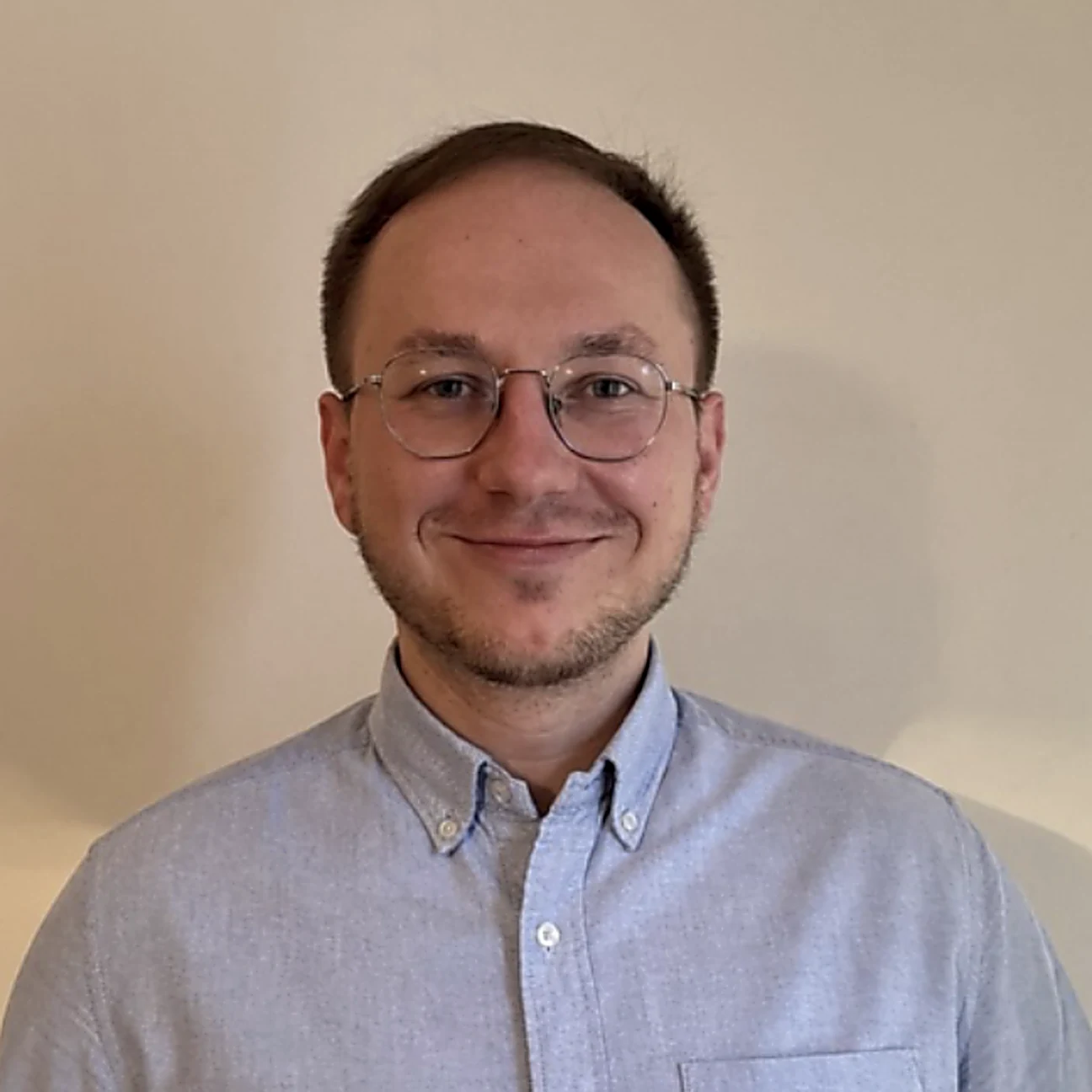
Paul Sobiecki — theoretical physicist
■ Who teaches the lesson

Paul Sobiecki.

I studied theoretical physics to understand how the universe works at its deepest level — black holes, quantum field theory, general relativity — and graduated Summa Cum Laude. I am actively working in physics, not only teaching it, and that is the part that keeps the teaching alive.

I teach because the thing standing between a student and a better grade is almost always specific, small and findable, and because nobody has had the time or the depth to go and find it. I know the subject as a practitioner. That means the syllabus is something I can see the shape of from outside, and can therefore shorten.

Most of the students I work with are not aiming at the top of the world. They want the grade their course needs, without the subject eating their year. That is a completely reasonable thing to want, and it is most of what I do.

Every lesson is taught by me, from the first hour to the last one before the exam. When the week is full, it is full.

Meet me in the free hour
■ Questions

What parents and students ask.

What actually happens in the free 60-minute lesson?What actually happens in a lesson?

A full clock hour of teaching, one to one, and nothing to prepare beforehand — I bring the problems. The student reasons out loud through material they believe they already know, so the real gap becomes visible rather than assumed. It ends with a straight assessment of where the problem actually is and what the work ahead actually looks like. Nothing is owed afterwards, including when the honest answer is that no tutor is needed.

Do you teach mathematics as well as physics?

Yes — in practice most students here want a physics tutor and a math tutor in the same person. Most physics that fails anywhere is failing because the mathematics underneath it is not secure: the algebra, the trigonometry, the calculus. Repairing them in the same hour, on the same problem, is what makes the repair hold.

Which curricula and examinations do you cover?

Physics and mathematics under essentially any system, because the subject underneath them does not change.

  • International — IB Diploma Physics HL and SL, Mathematics AA and AI, Internal Assessment and Extended Essay
  • British — A-Level, International A-Level, GCSE and IGCSE across AQA, OCR, Edexcel, Eduqas, WJEC and Cambridge International
  • American and Canadian — AP Physics 1, 2 and C, AP Calculus AB and BC, AP Statistics, honors and college-level courses, and provincial diplomas such as the Ontario OSSD
  • European — the Abitur, the Baccalauréat, the Maturité, VWO, Bachillerato and EvAU, the Esame di Stato, the Austrian Matura, the Polish matura
  • Asia-Pacific and the Gulf — the Singapore-Cambridge A-Level and O-Level, the Integrated Programme, the HKDSE, the HSC, VCE and ATAR subjects, and the British and American curricula taught throughout the UAE, Qatar and Saudi Arabia
  • Beyond school — physics and mathematics olympiads at every level, university admissions papers including the ESAT, TMUA, STEP and TOLC-I, and first- and second-year university courses in physics, mathematics and engineering

If yours is not on that list, say so — it is almost certainly the same physics with a different cover sheet.

How do lessons work across time zones?

Everything is online and one to one. Students currently work with me from Central European, Gulf, South-East Asian, East Asian and US Pacific time. The weekly slot is fixed in the first lesson and built around the student's school week, which for most families means a weekday evening or a weekend morning in their own city.

My child only needs a solid pass, not a top grade. Is this the wrong place?

No — that is the most common goal here, and it is the easiest one to hit properly. A comfortable pass is usually blocked by two or three specific things rather than by the whole subject, and clearing them is quicker than a year of general revision. The aim in that case is straightforward — the grade the course needs, and physics taking up a normal amount of the week instead of dominating it.

How does a lesson differ for a student with ADHD or dyslexia?

Mechanically. There is no class to keep pace with, so the lesson runs at whatever speed the work needs that day and stops when attention goes. Reasoning can be spoken rather than written, and written down once it has settled. A derivation can be rebuilt three times in one session without holding anyone up.

Access arrangements and formal provision sit with the school and with the people qualified to assess for them. What happens here is teaching, adapted to how a particular student actually thinks.

My child already has a strong grade. Is there anything left to gain?

Oh yes, more than people realize. A school teacher has thirty students and a syllabus to finish; a marketplace tutor has your child for as long as the booking lasts. Neither is built to take someone who is already good and make them exceptional. The distance between a strong grade and the level a selective physics, mathematics or engineering course expects is not more of the same material. It is the ability to attack a problem never seen before — a different skill, and one rarely taught at school because school has no time for it.

How do you get the top grade?

Not by covering more content. The last grade boundary is almost never about recall — it is about the precision of what gets written under the arithmetic (for example: the assumption stated, the direction named, the unit carried, the conclusion answering the question that was actually asked). That is a learnable habit, and it is the part school has no time to drill.

Can you help with physics homework, problem sets and revision?

Yes, though a lesson spent only on tonight's homework tends to fix tonight and nothing else. The usual arrangement is that a problem set becomes the raw material. We work through it, and every time something breaks we stop and repair the thing underneath it. Revision then gets planned around what the papers actually keep asking rather than around the order of the textbook.

Do you tutor university students and adults?

Yes. Undergraduate mechanics, electromagnetism, quantum mechanics, thermodynamics and the mathematical-methods courses that quietly decide degree classifications, plus engineering modules. Adults returning to the subject, and candidates preparing for quantitative-finance interviews, are on the same calendar as everyone else.

What if we move abroad next year?

Then nothing changes here, and that is one of the main reasons families choose a single online tutor over a local one. The school changes, the country changes, sometimes the curriculum changes — and the person teaching physics and mathematics stays the same, already knowing exactly what the previous system did and did not cover. Those handover gaps are invisible to each individual school, because each one only ever sees its own segment.

■ What it costs

One physicist, one calendar.

I teach every hour myself, so there is a fixed number of students I can hold at once. The first lesson is free, with no commitment at all.

$970/mounlimited90-minute lesson every week, plus unlimited extra lessons — take any hour my calendar has open, as often as you like, at no extra cost.

$670/mo60-minute lesson every week.

$270One 90-minute lesson, on its own.

$190One 60-minute lesson, on its own.

The monthly figure is flat whatever the calendar does, so five-week months and holidays cost the same as any other. The first lesson is completely free, with no commitment at all.

■ Where to start

Start with an hour, at no cost.Start by telling me what is going wrong.

Nothing to prepare and nothing to bring. I set the problems — one pitched slightly beyond where you are — and watch where the reasoning breaks. Nobody is expected to arrive impressive, and it is genuinely more interesting when they do not. You leave knowing exactly what is wrong, whether or not a second lesson ever happens.

Lessons are weekly and at a fixed time, so a place opening up depends on one closing. If the hour matters this term rather than next, it is worth taking the slot while it is there.

Book the free 60-minute lesson

A full clock hour · one to one · no obligation · a clear answer either way