ONE PHYSICIST Book free

Physics and mathematics tutoring, one to one and online, with Paul Sobiecki, theoretical physicist

Physics, understood. Not survived.

One-to-one physics and mathematics tutoring, online, with a theoretical physicist. The same person every week, from the first hour to the last one before the exam.

A full clock hour · one to one · in your own time zone

Gravity assist.

Momentum that is hard to build alone, borrowed from someone whose work runs from general relativity at one end to the AI and quantitative-trading firms that bring him their mathematics at the other. It moves a grade. It tends to move rather more than that.

A full clock hour · one to one · in your own time zone

Understanding is the shortcut.

Once a student can see why a result is true, they no longer have to remember it. Revision gets shorter, and a question nobody has practised stops being frightening and starts being answerable.

A full clock hour · one to one · in your own time zone

The starting point

Two or three things are costing the marks.

Almost nobody is failing at physics or maths as a whole. It is normally two or three specific things, sitting a year or so upstream of whatever the timetable says — and an hour is enough to find them.

01

It makes sense in the lesson and will not come out on the paper.

02

The physics is fine and the algebra underneath it is eating the marks.

03

Every past paper feels like a new paper, and nothing carries over.

Whichever it turns out to be, it has a name and it has a repair — and they are different repairs, which is why guessing costs a term and looking costs an hour.

Why more hours stop working

Effort is not the variable. Timing is.

Push a child on a swing for an hour, out of time with the swing, and almost nothing happens. Your arms ache; the amplitude barely moves. Push with a tenth of that force — but at the top of each arc, in phase with the motion already there — and within a minute you are asking them to hold on.

That is not a figure of speech. It is what the equations of a driven oscillator say, and it is what a stuck student looks like from the outside. The hours are already being spent. The past papers are already being done. Enormous energy is going into the system and almost none of it arrives in phase, because the thing being practised is not the thing being examined.

Force applied at the wrong moment is not progress. It is fatigue — and fatigue is what makes a capable teenager decide they are simply not a physics person.

Finding the phase takes a diagnosis, not a longer schedule. It means locating the one or two places where the reasoning actually breaks, usually a year or two upstream of the topic on the timetable, and driving there. After that the same student, spending fewer hours, starts moving in a way that looks implausible from outside. Nothing was added. The pushing was simply timed.

City lights at night photographed from orbit aboard the International Space Station
Photograph: NASA

A lot of people arrive having quietly decided they are not a physics person. That is almost never true. It is usually one specific thing that went wrong early, was never caught, and has been quietly charging interest ever since.

There is no entry test, no minimum grade, and nothing at all to prepare. You do not need to know what is wrong, or bring anything with you — working that out is my job, and I bring the problems. Turning up is the whole of the preparation.

The first hour is free, and it is a lesson rather than an interview.

Before anything else

Nobody has to arrive impressive.

The physicist

The physicist who gets you to your dream university.

Whatever that turns out to be — a course you already have your eye on, or somewhere you have not let yourself say out loud yet. It has never needed an exceptional student. It needs an accurate idea of where the marks are going, which almost nobody has and almost anybody can get.

Theoretical physicist, Summa Cum Laude

The mathematics was understood rather than survived — which is why it can be rebuilt from the bottom for you, at whatever depth you happen to need.

Research in relativity, quantum field theory and black holes

Including work that ruled out a class of black hole solutions. Finding the assumption a whole argument rests on is the exact move you need when a question stops looking familiar.

Satellite work

Real instruments, real error budgets. Uncertainty and error analysis were the job — and that is where marks quietly vanish in every practical and internal assessment.

AI companies, quantitative trading, startups

Physics as a working tool. Ask where linear algebra actually goes and the answer comes from someone who used it that week.

Conversations with Nobel laureates

Calibration: knowing how far above a syllabus a fifteen-year-old can safely be taken, and exactly when to stop.

Years of past-paper analysis

The same handful of ideas, examined over and over in different clothing. Knowing which is which turns a hundred past papers into about nine things worth practising.

One decision changes what is reachable. That is the entire argument for spending it on the right hour. Paul Sobiecki, theoretical physicist
Borrowed momentum

Gravity assist.

A spacecraft cannot reach the outer planets on the fuel it can carry. So it does not try. It falls toward a world it never intends to visit, bends around it, and leaves faster than it arrived, carrying away a sliver of that planet's momentum. Not one extra gram of fuel is burned. The whole gain comes from having passed close to something massive, at the right angle, at the right moment.

All of that is true of a teacher, and it is the only honest argument for choosing an expensive one. Hours are fuel, and the tank is fixed: the same seven days, the same tired evenings, the same finite attention. Past a point, more fuel changes nothing — a year of Sundays can be burned to arrive in precisely the orbit you were already in. What changes a trajectory is proximity to mass.

The mass here is the list above. None of it is on any syllabus, and all of it bends the path — because someone who has stood inside the real thing can see at once which part of a problem is load-bearing and which part is decoration.

A student does not have to become that. They have to pass close enough, at the right angle, and leave with speed they did not have. Spend real time near someone who does physics for real and you start reaching for the questions school never asks — and that habit does not stay behind in the lesson.

Mass is the whole mechanism. Nothing else in the manoeuvre matters, and nothing else can be substituted for it.

Method

What an hour actually looks like.

A clock hour, not a school hour. The extra fifteen minutes a forty-five-minute period does not have are where the work stops being revision and starts being physics.

01 — Diagnose

Show me how you think about this

Not which topic are you on. The student reasons out loud through something they believe they already understand. Within twenty minutes it is usually clear whether the failure is conceptual, mathematical or purely procedural. Those are three different problems wearing the same face, and each one needs an entirely different repair.

02 — Rebuild

From beneath, not patched

If the physics is failing because the algebra is failing, the algebra is fixed first — even when it sits two years upstream of the timetable. This is the slow part, and it is the part that never has to be done twice. What gets built here is the ability to derive rather than recall, which is the only thing that survives an unfamiliar question.

03 — Convert

Understanding into marks

Only then, past papers — under time, marked against the real mark scheme, with every lost point traced back to which of the three failures produced it. Every examination system rewards a specific shape of written argument. That shape is learnable, and school rarely teaches it.

Subjects

What gets taught.

The IB Diploma at an international school in Geneva or Singapore. A-Levels in London or Dubai. AP in the Bay Area. IGCSE almost anywhere. The syllabus changes; the physics does not.

School examinations

IB Physics and Mathematics at HL and SL, Analysis and Approaches and Applications and Interpretation, including the Internal Assessment and Extended Essay. A-Level and International A-Level Physics, Maths and Further Maths across AQA, OCR, Edexcel and Cambridge International. AP Physics 1, 2 and C, and AP Calculus AB and BC. IGCSE and GCSE Physics and Maths when the foundations need rebuilding before anything else will hold.

Olympiad and admissions

National and international physics and mathematics olympiad material, and the admissions papers set by selective universities — currently the ESAT, the TMUA and STEP; earlier candidates sat the PAT and the MAT. These reward invention rather than recall, and the material is approached the way a research problem is, not the way a syllabus is covered.

University and beyond

Classical and Lagrangian mechanics, electromagnetism, quantum mechanics, thermodynamics and statistical mechanics, relativity, linear algebra, multivariable calculus, differential equations and mathematical methods. Also engineering courses, adult learners returning to the subject, and problem-solving for quantitative-finance interviews.

Physics topics Kinematics and projectile motion · circular motion and gravitation · Newton's laws · momentum and collisions · work, energy and power · simple harmonic motion · waves, sound and optics · thermodynamics and ideal gases · electric fields and circuits · capacitors · magnetic fields and induction · atomic, nuclear and particle physics · quantum physics · special relativity · uncertainties, error analysis and practical write-ups.

Mathematics topics Algebra and functions · trigonometry · sequences and series · differentiation and integration · vectors and matrices · complex numbers · differential equations · probability and statistics · proof · numerical methods · mechanics and statistics options.

Where this happens

Taught from anywhere. To anywhere.

Finding an online physics tutor or a maths tutor usually founders on the clock. That part is easy here. Students in more than twelve countries: a Saturday morning lesson in Singapore is a Friday evening in San Francisco, and both have sat in the same week, alongside Geneva, London, Dubai, Hong Kong and Tokyo.

Lessons run on your clock. The weekly slot is fixed in the first hour, around the student's school week rather than mine — one physicist, one calendar, and whatever time zone you happen to keep.

Some of my students ended up even here. Most just wanted a better grade.

What is actually being bought

Less to learn than it looks.

The whole of mechanics — every collision, every pulley, every orbit a school will ever set — follows from a handful of statements you could write on the back of a boarding pass. That is not a simplification for beginners. It is the actual structure of the subject, and it is why physics is the most compressible thing taught at school.

Which means there are only two ways to hold it. A student can carry the compressed version, a few principles plus the ability to unpack them on demand — or they can carry the unpacked version, several hundred disconnected results, none of which imply each other, all of which must be memorised separately and none of which survive an unfamiliar question.

Both students look identical in a school test. They diverge completely the moment a paper asks something slightly new, and they diverge permanently at university, where the unpacked version simply runs out of memory.

Nobody chooses the unpacked version. They end up with it because nobody ever showed them the compressed one — and you cannot be shown a compression by someone who does not hold it themselves. That is the whole of what is being bought here: not more hours, not more worksheets. A shorter description of the same universe.

I do not teach shortcuts. I teach the structure the shortcuts were derived from, because the exam eventually asks for it. Paul Sobiecki, theoretical physicist
How the hour adapts

Attention, working memory, handwriting.

Some students lose marks to the physics. Others lose them to everything standing around the physics, and the difference is usually visible inside an hour.

A lesson with one student in it has no pace to keep up with. It runs at whatever speed the work needs that day, stops when attention goes, and starts again without anyone having missed a slide. Reasoning can be spoken rather than written, and a derivation can be rebuilt three times without holding anyone up.

That suits students with ADHD, dyslexia, dysgraphia and dyscalculia, for mechanical reasons rather than therapeutic ones. Access arrangements and formal provision sit with the school and the people qualified to assess for them. What happens here is teaching, shaped around how one particular student thinks.

Paul Sobiecki, theoretical physicist
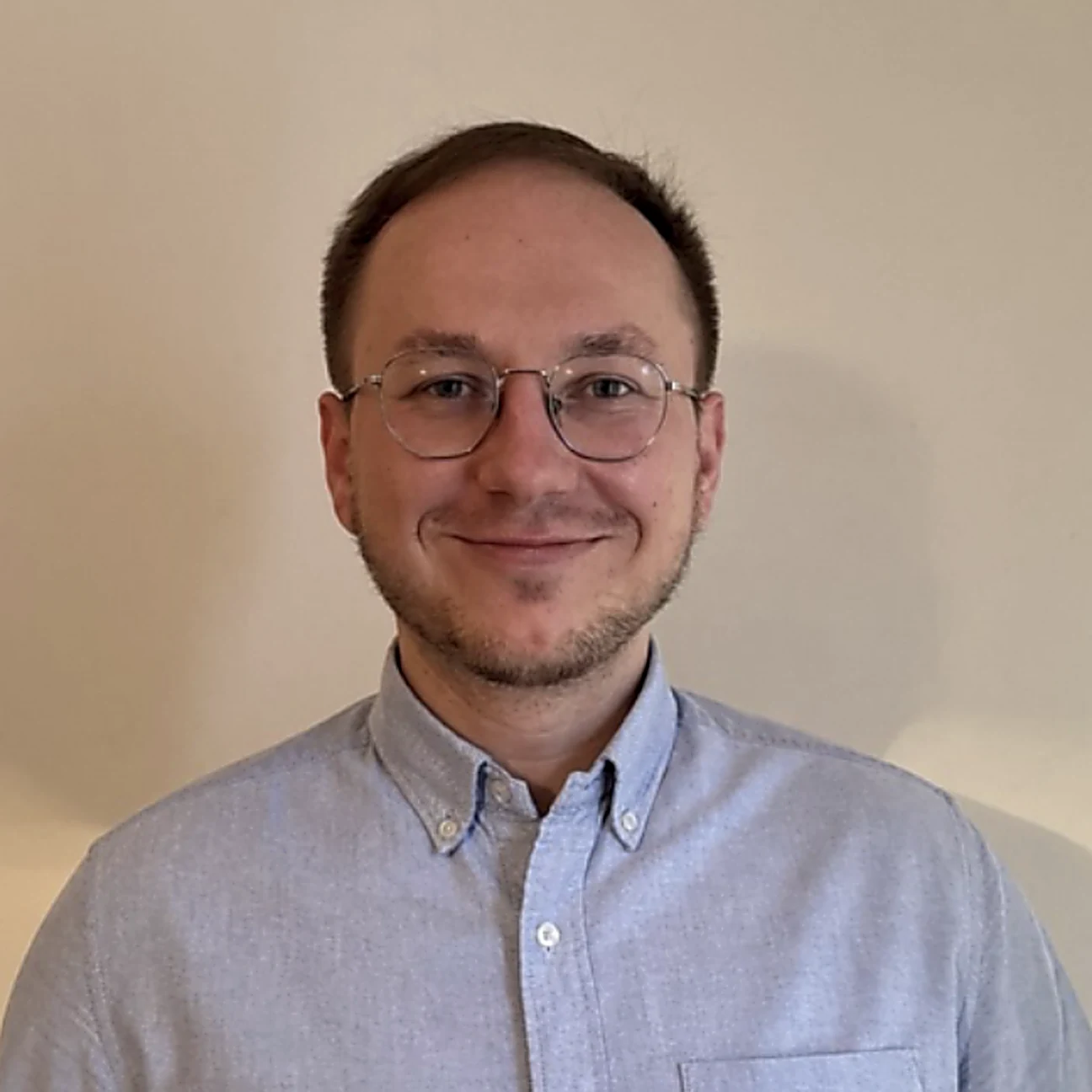
Paul Sobiecki — theoretical physicist
Who teaches the lesson

Paul Sobiecki.

I studied theoretical physics to understand how the universe works at its deepest level — black holes, quantum field theory, general relativity — and graduated Summa Cum Laude. I am actively working in physics, not only teaching it, and that is the part that keeps the teaching alive.

I teach because the thing standing between a student and a better grade is almost always specific, small and findable, and because nobody has had the time or the depth to go and find it. I know the subject as a practitioner. That means the syllabus is something I can see the shape of from outside, and can therefore shorten.

Most of the students I work with are not aiming at the top of the world. They want the grade their course needs, without the subject eating their year. That is a completely reasonable thing to want, and it is most of what I do.

Every lesson is taught by me, from the first hour to the last one before the exam. When the week is full, it is full.

Meet me in the free hour
Questions

What parents and students ask.

What actually happens in the free 60-minute lesson?

A full clock hour of teaching, one to one, and nothing to prepare beforehand — I bring the problems. The student reasons out loud through material they believe they already know, so the real gap becomes visible rather than assumed. It ends with a straight assessment of where the problem actually is and what the next twelve weeks would contain. Nothing is owed afterwards, including when the honest answer is that no tutor is needed.

Do you teach mathematics as well as physics?

Yes — in practice most students here want a physics tutor and a math tutor in the same person. Most physics that fails at HL, A-Level or AP Physics C is failing because the mathematics underneath it is not secure: the algebra, the trigonometry, the calculus. Repairing them in the same hour, on the same problem, is what makes the repair hold.

Which curricula and examinations do you cover?

IB Physics and Mathematics at Higher and Standard Level; A-Level and International A-Level Physics, Mathematics and Further Mathematics; AP Physics 1, 2 and C and AP Calculus; IGCSE and GCSE; national school-leaving examinations taught in English; university physics, mathematics and engineering courses; olympiad material; and the admissions papers, currently the ESAT, the TMUA and STEP.

What is yours?

How do lessons work across time zones?

Everything is online and one to one. Students currently work with me from Central European, Gulf, South-East Asian, East Asian and US Pacific time. The weekly slot is fixed in the first lesson and built around the student's school week, which for most families means a weekday evening or a weekend morning in their own city.

My child only needs a solid pass, not a top grade. Is this the wrong place?

No — that is the most common goal here, and it is the easiest one to hit properly. A comfortable pass is usually blocked by two or three specific things rather than by the whole subject, and clearing them is quicker than a year of general revision. The aim in that case is straightforward: the grade the course needs, and physics taking up a normal amount of the week instead of dominating it.

How does a lesson differ for a student with ADHD or dyslexia?

Mechanically. There is no class to keep pace with, so the lesson runs at whatever speed the work needs that day and stops when attention goes. Reasoning can be spoken rather than written, and written down once it has settled. A derivation can be rebuilt three times in one session without holding anyone up.

Access arrangements and formal provision sit with the school and with the people qualified to assess for them. What happens here is teaching, adapted to how a particular student actually thinks.

My child already has a strong grade. Is there anything left to gain?

That is the most common starting point here. The distance between a strong grade and the level a selective physics, mathematics or engineering course expects is not more of the same material. It is the ability to attack a problem never seen before — a different skill, and one rarely taught at school because school has no time for it.

How do you get a 7 in IB Physics, or an A* at A-Level?

Not by covering more content. The last grade boundary is almost never about recall — it is about the precision of what gets written under the arithmetic: the assumption stated, the direction named, the unit carried, the conclusion answering the question that was actually asked. That is a learnable habit, and it is the part school has no time to drill.

Can you help with physics homework, problem sets and revision?

Yes, though a lesson spent only on tonight's homework tends to fix tonight and nothing else. The usual arrangement is that a problem set becomes the raw material: we work through it, and every time something breaks we stop and repair the thing underneath it. Revision then gets planned around what the papers actually keep asking rather than around the order of the textbook.

Do you tutor university students and adults?

Yes. Undergraduate mechanics, electromagnetism, quantum mechanics, thermodynamics and the mathematical-methods courses that quietly decide degree classifications, plus engineering modules. Adults returning to the subject, and candidates preparing for quantitative-finance interviews, are on the same calendar as everyone else.

We relocate next year. Does this survive the move?

Yes, and it is one of the main reasons families use a single tutor rather than a local one. The school changes, the country changes, sometimes the curriculum changes — and the person teaching physics and mathematics stays the same, already knowing exactly what the previous system did and did not cover. Those handover gaps are invisible to each individual school, because each one only ever sees its own segment.

Where to start

Start with an hour, at no cost.

Nothing to prepare and nothing to bring. I set the problems — one pitched slightly beyond where you are — and watch where the reasoning breaks. Nobody is expected to arrive impressive, and it is genuinely more interesting when they do not. You leave knowing exactly what is wrong, whether or not a second lesson ever happens.

Lessons are weekly and at a fixed time, so a place opening up depends on one closing. If the hour matters this term rather than next, it is worth taking the slot while it is there.

Book the free 60-minute lesson

A full clock hour · one to one · no obligation · a clear answer either way